

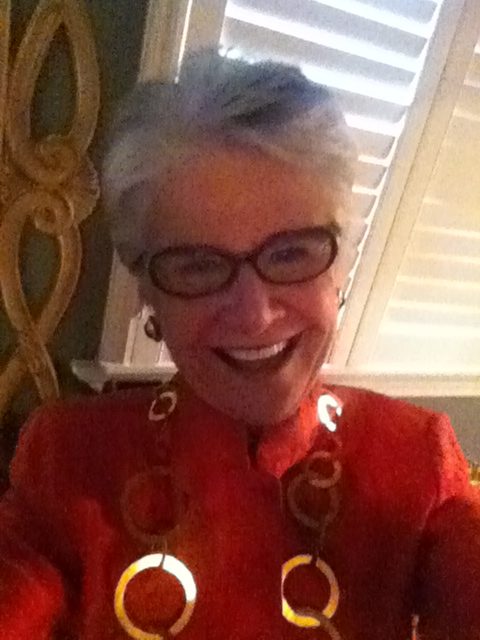
“I had a hunch it would work, and it did.”
At 39, Carol Allen was superintendent of all the public schools in New Orleans. Then she dropped everything to marry a man in Paris. The first things she did were to enroll in a French immersion class, and join WICE.
The same confidence that led her across the ocean allowed her to create the Paris Writers Workshop in 1989, which would become the longest running writing workshop in Europe. Prior to this summers’ edition, Allen shared her memories of the early days of the workshop.
One day the committee was brainstorming what we could do to bring more money to the organization, and I said, “What about a writer’s workshop?” It just fell out of my mouth, I hadn’t thought about it.
The chairperson asked, “Why’d you say that?” I replied, “It’s just a hunch.” She took it to the board and they voted to try it once.
I had a writing background in the sense that I had planned to be a writer when I was 19, but then I became an educator. But I knew the literary world, so I got put in charge.
How has the workshop evolved over time?
We started with three classes: fiction, nonfiction, and poetry. Stephen Englund was our first nonfiction writer. Fiction was overloaded so we had to add a second fiction writer. Our poet, Susan Ludvigson, had a husband, Scott Ely, who was a fairly well-known fiction writer, so we brought him in.
One day I answered the telephone and it was D.M. Thomas, the famous writer who wrote The White Hotel. I grabbed the phone hard and sweated through it. He came the first time, and I think he ended up coming three years in a row. He was extremely popular, and smoked like a chimney.
We didn’t add any more genres in my time. The most important thing was broadening our author base to get instructors people would recognize. Here’s the advantage: if you’re running a writers’ workshop in Paris, it’s easy to get a writer to come be on your faculty, because they’d love to come to Paris!
Did you look at other workshops or programs that existed at the time?
Never. I leap and ask questions later. Everything just fell into place. The person who leads a project has to be passionate about that topic. Never ask somebody to do that job if they’re on the fence about it. It’s an either-yes-or-no thing.
One big mistake we made is we did not follow up with our students. I would encourage you to start every class in the workshop with “Please let the WICE office know when you publish your first work.”
Why do you think the workshop took off?
There are a lot of closet writers. People have an urge to write. What I didn’t expect was students from outside Paris — from the US, some from the UK. That was a big surprise.
Did you ever take the workshop yourself?
I tried to sit in on at least one class every workshop, and I was mostly interested in fiction. There was one nonfiction writer, Peter Kurth, I sat in on his class just because he was such a good teacher. He had an incredible sense of humor.
What would you say to a friend who is thinking about getting into writing?
I’d ask what their goals are, what they want to do. When I was in Paris we would meet at somebody’s apartment every once in a while and share our work. I’d encourage someone who’s thinking about it to try a writers’ group. If they don’t know of one, make one.
I went through so many different writers’ workshops and groups and online classes over the years. After getting a doctorate in education, I went back and got a master’s in writing for children. It’s kind of a virus — it never leaves you.
If you could speak to yourself at the moment when the idea was forming, what would you say?
Looking back, I would probably say, “Are you out of your mind?” But that’s not the way I am. I was so sure of myself.
I do not ever like to go into anything doubting that we can make it happen. It’s about looking forward with confidence, but also expecting hard work from yourself and everybody joining you.
One year when I was superintendent, we had a required state exam and our scores had not been very good the year before. So I announced: “Ramona has booked the ballroom of the Hyatt Regency Hotel for this date in June, where we are going to celebrate our increase in test scores.” We did it. Test scores went up.
Are there any funny stories or interesting anecdotes you want to share?
I remember Nancy Huston was one of our invited fiction writers. She gave a lecture — we always had our visiting writers give a lecture to the entire workshop. She stood up and started her speech with this line: “If you’re going to be a good writer, you have to kill your mother.”
Everybody went, “Whoa.” After she explained what she meant, we understood: you can’t worry about other people judging you by what you say. You have to go ahead and write what you’re supposed to write.


One response to “How Carol Allen’s crazy idea sparked the Paris Writers Workshop”
So true about “killing your mother” if you want to write, but also hard to do!